Shift Type Requirements
Requirements define staffing and who may work each staffed shift. Add coverage for the working shifts and dates you need. Preferred staffing and coefficients are optional refinements.
Real scenario example
The anonymized ward requires three senior nurses on N+ every day. It also
sets N to a minimum of 12 and a preferred level of 13 from All Nurses w/o
Students. Similar rules cover day and evening shifts.
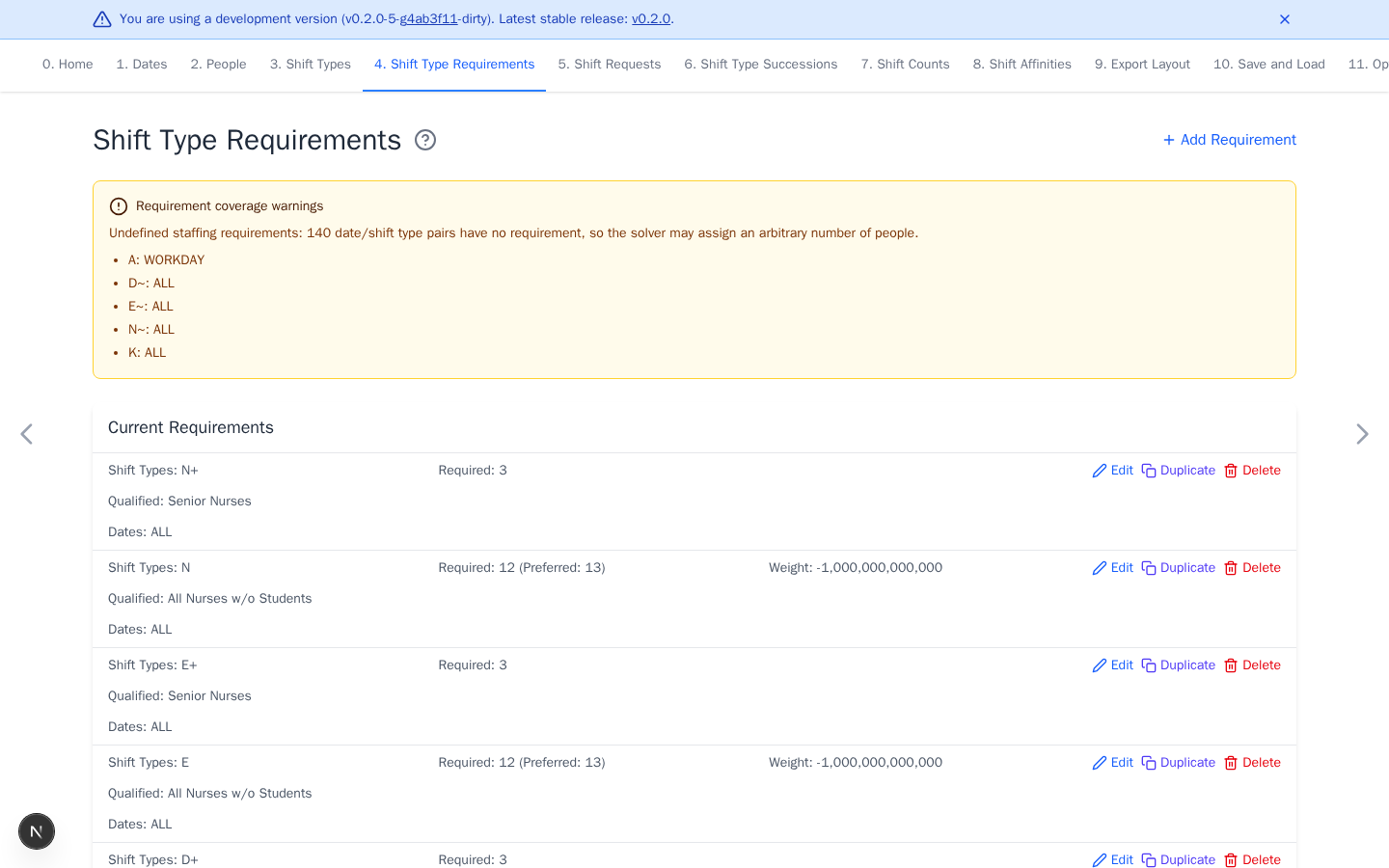
The warning lists special shifts without fixed staffing totals. Review every warning. Leave a pair undefined only when other rules intentionally control it.
Add coverage requirements
- Select Add Requirement.
- Select one shift type or group.
- Enter Required Number of People.
- Select Qualified People and Dates.
- Select Add.
Staffing behavior
- With no preferred value, required is an exact staffing level.
- With a preferred value, required is the hard minimum and preferred is the hard maximum. The weight penalizes the gap from preferred.
- Qualified People forbids everyone else from the selected shifts and
dates. Use
ALLwhen everyone is eligible. - A shift group has one aggregate total across its member shifts.
Refine staffing
Set Preferred Number of People and a negative weight when staffing may vary between a hard minimum and maximum. Leave it empty for an exact requirement.
Shift-type coefficients change how assignments contribute to that aggregate.
Leave them at 1 unless the workplace rule requires another contribution.
Do not define overlapping coefficients for a shift and a group containing it.
Resolve warnings
Add a requirement for every undefined date and working-shift pair. Review duplicate coverage and remove unintended overlap. Intentional layered requirements are valid, and the solver applies all of them.
Continue with Shift Requests or go directly to Optimize and Export.